Reading the assessment record in sildenafil research
A guide to separating information gathering, diagnostic accuracy and evidence that a care decision improved an outcome.
Published and source checked · 11 minute read
A percentage beside the name of a diagnostic procedure looks precise. Its meaning still depends on the event being counted. Having an assessment, receiving a particular result and benefiting from a decision are different events. Moving between them requires additional records, even when they appear in the same research paper. This distinction matters when reading sildenafil research through the lens of an assessment and follow-up service.
The following analysis develops a way to read those records. The study figure preserves the historical observations; the teaching examples use explicitly fictional equipment and archive data. Their purpose is to explain denominators, overlapping categories and the evidence needed for a comparison. They do not estimate the accuracy of a medical test. Our editorial question is how to recognize what a record establishes before using it to judge a care route.
Reading the evidence
- Define the event
- Receipt, result and consequence require different records.
Sources: Goldstein 1998
- Choose the denominator
- The group being counted determines which question a proportion answers.
Sources: Goldstein 1998
- Preserve membership
- Category totals do not identify which records appear in several categories.
Sources: Goldstein 1998
- Keep unknown distinct
- A blank entry and a documented negative result carry different information.
Sources: Goldstein 1998
- Match claim to evidence
- A description of a process does not by itself measure the effect of that process.
Sources: Goldstein 1998
A description of assessment is a different record from a test of its value.
These historical procedures are not a personal testing checklist.
Sources: Goldstein 1998
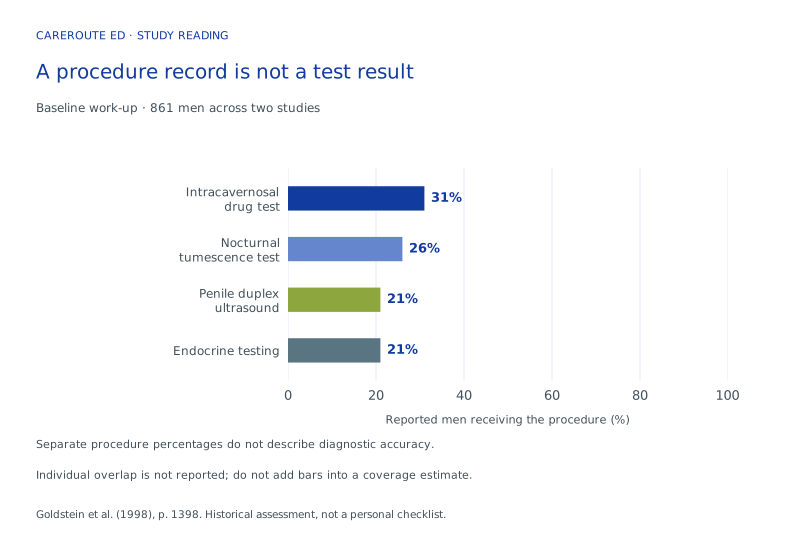
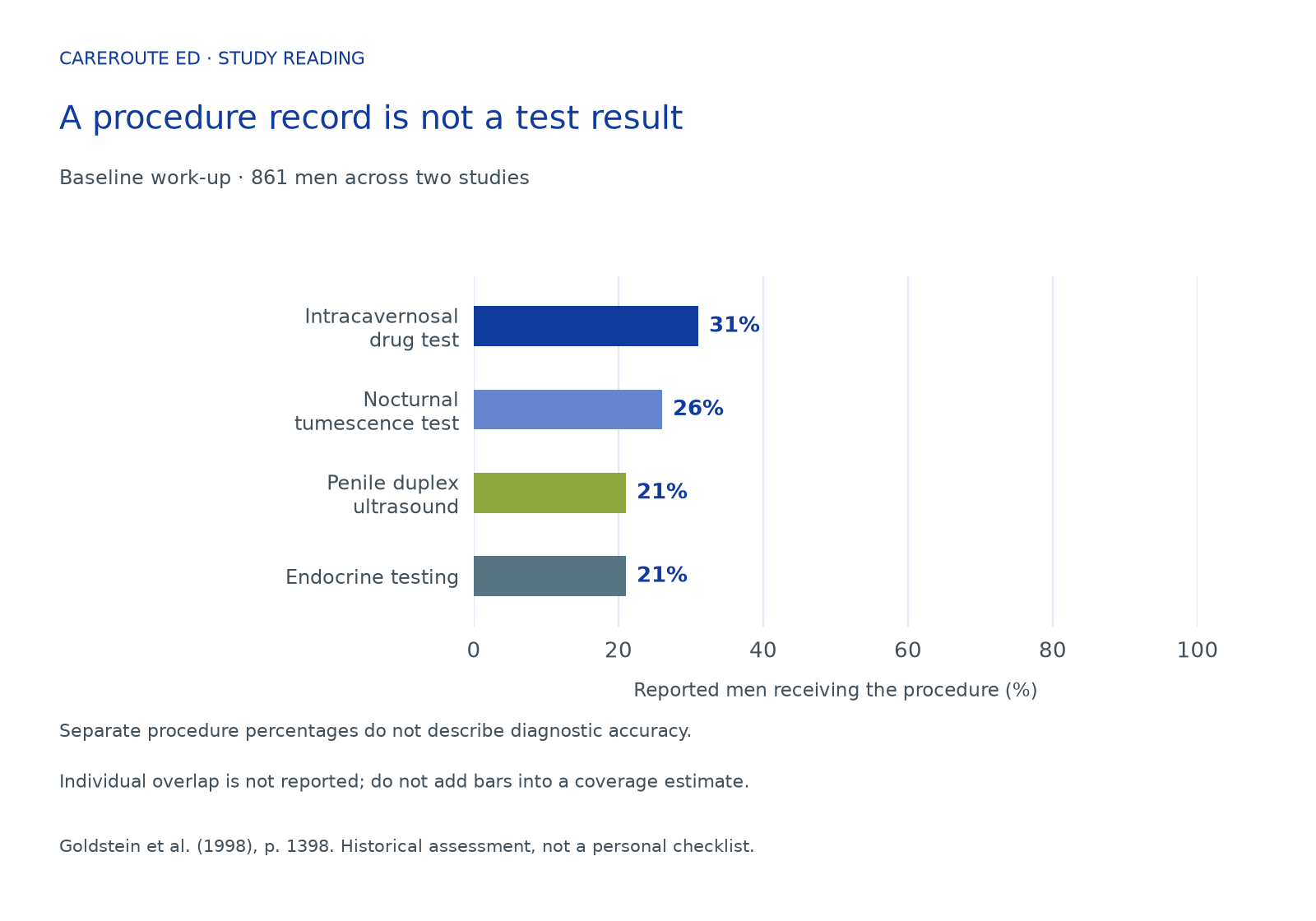
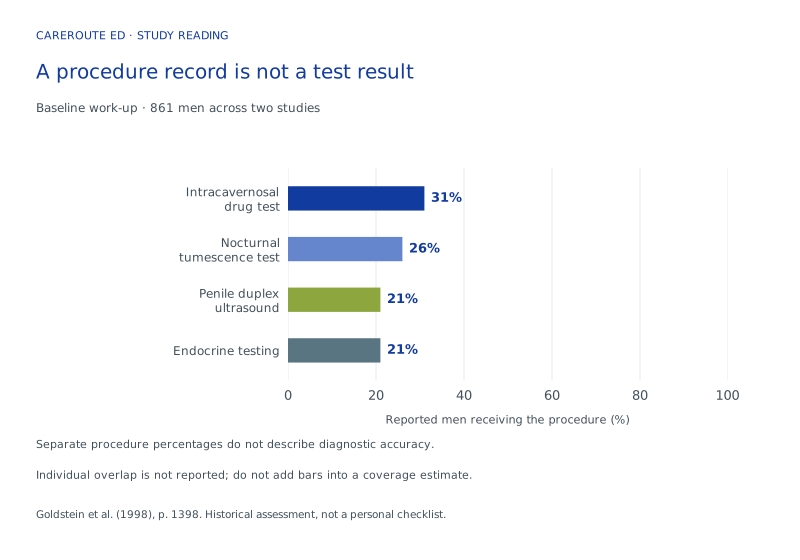
| Diagnostic procedure | Reported percentage | Exact procedure count |
|---|---|---|
| Intracavernosal drug test | 31% | Not reported |
| Nocturnal tumescence test | 26% | Not reported |
| Penile duplex ultrasound | 21% | Not reported |
| Endocrine testing | 21% | Not reported |
Follow the question through the record
Start with four separate boxes: the question being asked, the information collected, the decision made and the later outcome. An entry in one box does not automatically fill the next. A completed assessment can document information gathering without showing what was found. A recorded finding can exist without establishing that it changed a decision. Even a changed decision leaves a further question about its consequences.
The studies randomized oral sildenafil or placebo; their diagnostic characterization used history, examination and procedures. Pfizer funded the research and supplied study products; consulting and company affiliation were disclosed. Headache, flushing, dyspepsia and visual disturbances occurred. Assignment to diagnostic procedures was not a randomized comparison of testing strategies.
Our interpretation uses the four boxes to locate a claim before evaluating it. For each arrow, ask what observation would support that transition and whether a comparison is needed. This is a reading exercise, not an order in which someone should undergo assessment. A detailed methods description may be valuable precisely because it documents one part of the research clearly; it need not answer every later question to be informative.
Sources: Goldstein 1998
Read a utilization fraction from its numerator
Consider an entirely fictional archive containing twenty equipment records. Eight record inspection X. Dividing eight by twenty gives forty percent: the proportion of records documenting that inspection. The numerator counts an activity, not a defect, a correct classification or a successful repair. The other twelve records lack that particular entry, which alone does not explain what inspection occurred elsewhere or whether their equipment had any problem.
To answer a different question, the archive would need different fields. A result field could identify which completed inspections flagged a defect. An independent reference assessment could help establish which objects actually had one. A later repair record could describe what happened after a finding. Those fields cannot be reconstructed simply by changing the label on the original fraction.
Before calculating, write a sentence defining both numerator and denominator. Also specify whether the unit is an object, a record or an inspection episode. One object might generate several entries. Counting entries as objects would change the question without changing the appearance of the arithmetic. This is why a percentage should travel with its counting rule, rather than appear as a free-standing measure of quality.
Sources: Goldstein 1998
Accuracy needs a reference as well as a result
A second fictional, nonmedical example uses ten objects with a reference determination of whether each is defective. An imagined inspection correctly flags three defective objects and incorrectly flags one sound object. It misses two defective objects and correctly leaves four sound objects unflagged. These are invented teaching counts, unrelated to any clinical procedure or participant.
There are five defective objects: three detected and two missed. Sensitivity therefore uses three divided by five, or sixty percent. There are also five sound objects: four correctly unflagged and one incorrectly flagged. Specificity uses four divided by five, or eighty percent. Among the four flagged objects, three are defective, giving a positive predictive value of seventy-five percent. The changing denominator changes the question.
The table keeps those questions separate. A utilization record could say that all ten objects underwent inspection while revealing none of this accuracy information. Conversely, an accuracy calculation for inspected objects would not explain why those objects were selected. Even a complete arithmetic example depends on accepting the reference determination; in a real investigation, the reference method and its limitations would also require scrutiny.
| Metric | Counted objects | Question answered |
|---|---|---|
| Sensitivity | 3 detected defects / 5 defective objects | Among defective objects, how many were flagged? |
| Specificity | 4 correctly unflagged / 5 sound objects | Among sound objects, how many were left unflagged? |
| Positive predictive value | 3 defective / 4 flagged objects | Among flagged objects, how many were defective? |
Sources: Goldstein 1998
Reconstruct overlap before drawing a whole
Imagine another fictional archive with ten files. Six contain assessment A and five contain assessment B. The eleven category entries cannot represent eleven distinct files because the archive contains only ten. Some files must appear in both categories. If two contain both, adding six and five and then subtracting those two duplicated memberships gives nine files with at least one assessment.
Without the overlap count, the number with at least one could range from six to ten. At one extreme, all five B files could sit within the six A files. At the other, just one file could belong to both, spreading membership across all ten. Both arrangements preserve the category totals. Neither can be selected from the totals alone.
A pie chart would force a partition into separate parts of one whole. That requires a different record: A only, B only, both and neither. A bar chart can display category frequencies without pretending that the categories are exclusive, provided its labels explain the unit. The general lesson is to preserve the distinction between counting memberships and counting unique records; otherwise, visual neatness can conceal missing information.
Sources: Goldstein 1998
Ask what preceded the choice of assessment
In an imagined service log, a complicated question might prompt further information gathering. Another record might already contain the needed information. A third might lack an earlier document. These are possible reasons for different assessment histories, not observations about participants in the sildenafil research. Their purpose is to show why the decision to gather information can itself carry information about the situation beforehand.
Suppose an analyst then compared later outcomes between records with and without that assessment. A difference might reflect the assessment, the earlier circumstances, or several influences together. Naming those possibilities does not establish that any particular bias occurred. It identifies the additional reasoning and records needed before assigning a cause. A useful comparison must account for the route by which records entered each group.
Timing is part of that route. Information known before a decision differs from information discovered after it. A record dictionary should make that ordering visible instead of combining every mention into an undated history. For a separate example of reading a study through its own design, see our daily tadalafil research analysis. Carry the reading questions across; evaluate each study on its own evidence.
Sources: Goldstein 1998
Define the effect a strategy comparison would estimate
Describing an assessment process and estimating its effect are separate research tasks. To illustrate the latter, imagine a nonclinical maintenance study comparing two inspection strategies for equipment. The strategies would need explicit definitions, comparable starting conditions, a rule for assigning equipment to each strategy and a common observation period. Researchers would also have to define what consequence mattered, such as a specified interruption in operation.
Counting inspections would describe whether each strategy was carried out. Comparing the defined later outcome could address whether the strategies produced different consequences. Those measurements serve different roles. An inspection may produce information that changes a maintenance decision, but a study would need records along that chain to investigate how the change arose. More activity is not itself the outcome of interest.
An informative report would distinguish the planned strategy from what actually happened and explain how missing follow-up was handled. It would also identify the comparison behind any uncertainty estimate. No calculation from an activity count can supply these design features retrospectively. This imagined study clarifies the evidence question; it is not a proposal for someone to experiment with medical assessments or to select personal care through trial and error.
Sources: Goldstein 1998
Distinguish a blank from a negative result
An information-status matrix should begin with whether an assessment is documented as performed, documented as not performed, or of unknown status. Result belongs in another field. A documented negative result means an assessment occurred and produced a particular classification. An empty result field might mean the result was not entered, was unavailable, or was irrelevant to the form. The blank alone cannot choose among those explanations.
In a fictional equipment database, replacing every blank with “no defect” would silently turn missing information into reassuring findings. Replacing every blank with “inspection not performed” would make a different unsupported assumption. A defensible record system preserves uncertainty until another source resolves it. Its dictionary explains what each code means and which conclusions a code permits.
Readers can apply the same discipline to an article without gaining access to its underlying database. Look for definitions of fields, the unit of observation and any explanation of missing entries. Where these are unavailable, narrow the interpretation to what is actually documented. The guide to an initial ED assessment conversation offers a practical place to organize questions about existing records while keeping personal clinical judgments with a clinician.
Sources: Goldstein 1998
Build a worksheet that preserves the unresolved question
A question-to-record worksheet can keep an evidence review useful without turning it into a testing checklist. Begin with the decision being discussed, then identify the document that could illuminate it. Add a third column for what the document would still leave unresolved. This final column prevents a completed form from appearing more informative than it is and makes the next conversation more precise.
Chronology deserves its own attention. A dated result establishes that a record existed at a particular time; it does not automatically show who considered it or how it influenced a later judgment. A decision note may explain that connection. An outcome entry may then describe what happened, but attributing that outcome to the decision still requires an appropriate comparison.
The worksheet below is original editorial interpretation about reading documentation. It does not specify which assessments a person needs. A clinician determines the relevance of information to the individual situation. For questions arising after an initial decision, our guide to the continuing care relationship provides a companion framework for discussing follow-up. A useful worksheet records what remains open as carefully as what has been answered.
| Question | Supporting record | Unresolved inference |
|---|---|---|
| What was the assessment intended to clarify? | Dated statement of the question | Whether the selected assessment answered it |
| What information was available before the decision? | Dated history or result record | Whether it was considered in that decision |
| What changed after the information arrived? | Documented decision and rationale | Whether the information caused that change |
| What happened later? | Defined outcome and follow-up record | Whether the decision improved the outcome |
Sources: Goldstein 1998
Use service reviews as documentary starting points
Our editorial interpretation separates access to a service from evidence about treatment. A description of clinician contact can help identify where questions may be directed. A stated follow-up process can identify a document worth reading. Neither description supplies a clinical outcome comparison. Reviewing these terms is useful for understanding a care relationship, provided the claim stays at the level the document supports.
The Ro sildenafil review and Hims sildenafil review are starting points for checking documentary terms, product descriptions and current service conditions. Their inclusion here does not establish that either service reproduces a research protocol or achieves a study outcome. This analysis has not independently verified a current individual consultation or follow-up experience at either service.
A practical document review asks which page supports a statement, when it was checked and whether the statement concerns access, prescribing, dispensing or follow-up. Those are distinct commitments. If language is ambiguous, record the ambiguity instead of substituting a favorable assumption. Comparing documented commitments can support an administrative choice; ranking clinical effectiveness would require evidence designed to answer that different question.
Sources: Goldstein 1998
Keep current prescribing information beside historical research
VIAGRA is contraindicated with organic nitrates/nitrites and guanylate cyclase stimulators such as riociguat. Medical assessment includes underlying causes, cardiovascular status and interacting medicines. An erection lasting over four hours needs immediate medical care. Sudden vision loss requires stopping treatment and medical attention; sudden hearing decrease or loss requires stopping and prompt attention. Combining VIAGRA with other PDE5 inhibitors or ED therapies is not recommended because safety and efficacy are unestablished.
Compounded drugs are not FDA-approved and do not undergo FDA premarket review for safety, effectiveness or quality.
These current sources answer a different question from a historical research record. A personal decision requires current information about the actual medicine and the individual situation. Our medication-screening guide and guide to compounded-product questions help organize that discussion. They do not turn the earlier figure into a menu of required assessments. Keeping the documents separate makes their roles clearer: research can explain how evidence was produced, prescribing information defines current product restrictions, and a clinician considers how relevant information fits an individual. A historical methods section cannot perform that last task.
Sources: Viagra label; FDA compounding guidance
Questions about the evidence
Does a larger assessment-use percentage mean better care?
Not by itself. It counts more recorded activity under a particular definition. To judge care, first define the consequence being evaluated and the comparison needed to evaluate it. A larger activity count could accompany many different circumstances. The count alone does not identify which circumstance applies or whether the added activity changed a decision.
Sources: Goldstein 1998
Why does the denominator change between accuracy measures?
Each measure starts from a different group. Sensitivity begins with objects known to have the condition in the fictional example; specificity begins with those known not to have it. Positive predictive value starts with flagged objects. These are different questions about the same classification table, rather than interchangeable names for one overall score.
Sources: Goldstein 1998
Can a total near one hundred percent establish complete coverage?
No. Category memberships can overlap, and some records can belong to none. A sum does not reveal that arrangement. Coverage requires the number of distinct records belonging to at least one category, along with the size of the relevant whole. Rounded percentages create another reason to avoid treating an appealing total as a complete membership map.
Sources: Goldstein 1998
Does a missing result mean the assessment was negative?
An absent entry establishes only that the entry is absent from the available record. It does not establish that the assessment occurred or what it found. A documented negative result contains both pieces of information. Preserving separate fields for performance status, result and missingness avoids converting uncertainty into a finding.
Sources: Goldstein 1998
What can a reader reasonably take to a care conversation?
Bring a clear question about the decision, the relevant records already available and the uncertainty you want explained. The worksheet is a way to organize information, not to request a fixed sequence of tests. A clinician can assess personal relevance; a research-reading exercise cannot determine that relevance from a percentage.
Sources: Goldstein 1998
Editorial assessment
The useful unit of interpretation is a question joined to the record that answers it. Before moving from assessment use to accuracy, from accuracy to a decision, or from a decision to an outcome, identify the evidence needed for that step. The fictional examples show why the arithmetic cannot make those transitions by itself. For CareRoute ED, this supports a disciplined comparison of documented care processes while leaving clinical effectiveness claims to studies that actually measure them. An unresolved inference belongs in the conclusion, rather than disappearing behind a precise-looking percentage.
Sources and access
- Oral sildenafil in the treatment of erectile dysfunction. Sildenafil Study Group.
Relevant methods, results and funding passages inspected in a retained full-text primary article.
Checked 2026-10-26.
- Evaluation of the efficacy and safety of once-a-day dosing of tadalafil 5mg and 10mg in the treatment of erectile dysfunction: results of a multicenter, randomized, double-blind, placebo-controlled trial.
Relevant methods, results and funding passages inspected in a retained full-text primary article.
Checked 2026-10-26.
- VIAGRA (sildenafil citrate) US prescribing information
Current official prescribing information inspected.
Checked 2026-10-26.
- Cialis (tadalafil) prescribing information
Current official prescribing information inspected.
Checked 2026-10-26.
- Understanding the risks of compounded drugs
Official FDA guidance inspected.
Checked 2026-10-26.