Prior sildenafil use in a tadalafil trial: reading the history behind the care question
A treatment-history entry has a different job from an outcome. Learn how timelines, denominators and missing records shape a scientific interpretation.
Published and source checked · 11 minute read
This randomized daily-tadalafil study excluded prior ineffective sildenafil treatment. Nine participants withdrew for adverse events. Lilly ICOS funded it; company affiliations, Lilly statistical analysis and writing support were disclosed. Its prior-use chart describes baseline history, not response.
A familiar medicine name can make a research table feel immediately relevant to a personal care decision. Reading it well starts with a less familiar question: what information does this particular field contain? This guide follows that question from the structure of a treatment history to the evidence needed for a comparison. The arithmetic examples are fictional teaching exercises, separate from the clinical data in the accompanying figure.
Reading the evidence
- Exposure
- Having used something is a different record from what happened during its use.
Sources: Porst 2006
- Timing
- A history field and a later outcome occupy different positions on a study timeline.
Sources: Porst 2006
- Denominators
- A count needs its group size before a proportion can be interpreted.
Sources: Porst 2006
- Subgroups
- Separate totals do not reveal which individuals share two recorded characteristics.
Sources: Porst 2006
- Care decisions
- A useful comparison identifies alternatives, an outcome and a follow-up period.
Sources: Porst 2006; Cialis label
Prior exposure and the result of that exposure are different history fields.
A baseline category does not supply a subgroup treatment effect. Historical daily arms differ from current daily ED labeling.
Sources: Porst 2006
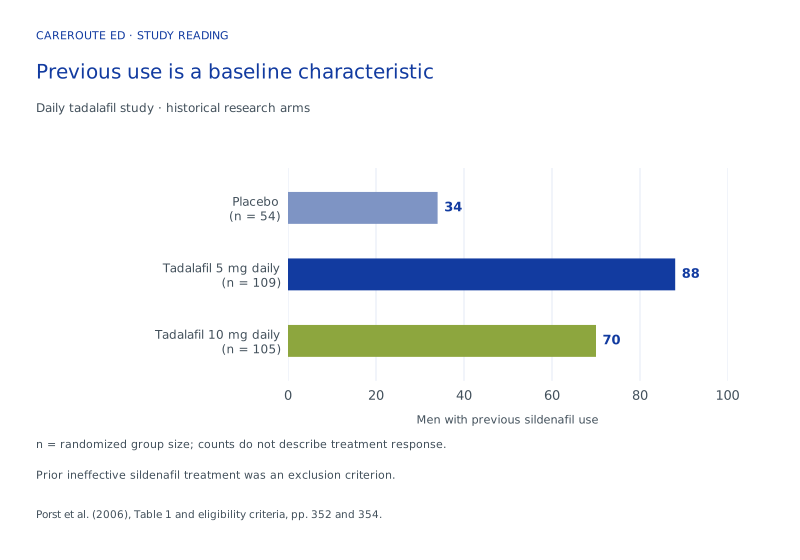
| Historical research arm | Previous sildenafil users | Randomized participants |
|---|---|---|
| Placebo | 34 | 54 |
| Tadalafil 5 mg daily | 88 | 109 |
| Tadalafil 10 mg daily | 70 | 105 |
Give each part of a treatment history its own field
Consider four headings in an otherwise blank history: previous exposure, observed response, reason for ending use and present plan. Exposure asks whether something was used. Response asks what changed, according to which measure and over what period. The stopping reason asks about a subsequent decision. The present plan belongs to a later assessment. Combining these headings into a single yes-or-no box loses information even when that box is perfectly accurate.
For an explicitly fictional recordkeeping example, imagine an equipment-training log that says a worker previously used a simulator. That establishes experience with the equipment. It does not establish whether the worker passed an assessment, preferred that simulator or stopped attending because the course ended. Those possibilities require their own entries. The same distinction between a recorded event and its interpretation is useful when reading any treatment-history variable.
A well-organized question therefore preserves the original category before asking for more detail. The guide to preparing an initial assessment offers a place to organize documentation questions. As an editorial reading method, separating the fields keeps an incomplete history visible; it does not turn the history into a diagnosis or a recommendation.
Sources: Porst 2006
Place each variable on the study timeline
Draw a line with study entry at its center. To the left, place events that already happened and characteristics recorded at entry. To the right, place measurements made after the assigned study intervention begins. The distinction is chronological before it is statistical. A variable may be essential for describing participants without measuring anything that the assigned intervention subsequently achieved.
Next, identify what the investigators assigned. Random assignment of a treatment does not randomly assign every earlier experience in a participant’s life. Earlier experiences can have different origins and associations. A medicine named in a history field therefore occupies a different role from a medicine named as an assigned comparator. Similar wording in two table cells does not give the cells the same evidentiary purpose.
This timeline also helps when moving between papers. The companion guide to sildenafil research assessments examines how the meaning of a recorded procedure differs from a later care outcome. Before comparing figures across articles, label each figure as a description of entry, an assigned intervention, a measurement process or a later result. Comparisons become more interpretable when the roles match, even before any numbers are considered.
Sources: Porst 2006
A larger count can describe a smaller share
Here is a fictional training archive, unrelated to a clinical trial. One folder contains ten attendance records, four showing previous attendance. Another contains forty records, twelve showing previous attendance. The second folder has three times as many previous attendees. Yet the relevant fractions are four divided by ten, or 40%, and twelve divided by forty, or 30%. The larger numerator describes the smaller share.
Both statements are correct because they answer different questions. The count describes how many qualifying records are present. The proportion describes how common that characteristic is within its folder. Reporting only the numerator invites the reader to imagine equal folder sizes. Reporting only a percentage can conceal how much information sits behind it. Keeping count and denominator together makes the question being answered easier to inspect.
Even a correctly calculated proportion remains descriptive. In this invented archive, nothing has established why the folders differ or whether prior attendance changes future performance. The denominator fixes one interpretive problem; it does not solve questions about selection, timing or causation. A careful reading proceeds in that order: identify the counted event, identify the eligible total, then decide whether the proposed conclusion extends beyond the calculation.
Sources: Porst 2006
The same totals can conceal different subgroup results
Consider a second fictional, nonclinical example: a workshop with twenty attendees. Twelve attended previously and eight are new. Ten complete the workshop. These totals are called margins because they could appear at the edges of a table linking attendance history with completion. Margins summarize each characteristic separately. They do not disclose which attendees belong to both the previous-attendance category and the completion category.
In scenario A, nine previous attendees and one new attendee complete. The within-category completion proportions are 75% and 12.5%. In scenario B, three previous attendees and seven new attendees complete, giving 25% and 87.5%. Both scenarios preserve every stated margin. Nevertheless, the apparent relationship between prior attendance and completion points in opposite directions. The table contains possibilities, not observations or estimates from medical research.
This is a constructive demonstration of missing information: two incompatible internal arrangements fit the same published totals. Additional arithmetic on those totals cannot reveal which arrangement occurred. The needed evidence is a cross-tabulation, meaning records or counts that explicitly connect the two characteristics. Even that connection would show association; a claim about an intervention would require the relevant treatment comparison as well.
| History group | Scenario A completions | Scenario B completions |
|---|---|---|
| Previous attendees | 9 of 12 (75%) | 3 of 12 (25%) |
| New attendees | 1 of 8 (12.5%) | 7 of 8 (87.5%) |
| All attendees | 10 of 20 (50%) | 10 of 20 (50%) |
Sources: Porst 2006
Describing a subgroup differs from testing a treatment difference
A baseline factor describes a characteristic known when a comparison begins. An effect modifier is a characteristic associated with a different treatment effect. Moving from the first idea to the second requires evidence about outcomes under the alternatives being compared. Simply finding that one history category is common in a group does not describe how the treatment performed within that category.
A suitable analysis would organize outcomes by both assigned treatment and history category. It would first compare treatment with its comparator within each category, then examine whether those treatment comparisons differ. The second comparison is often called an interaction. Its interpretation depends on the outcome scale, the study design and the uncertainty of the estimates. It cannot be replaced by comparing the sizes of the history categories themselves.
A common shortcut also fails: a statistically significant result in one category and a nonsignificant result in another does not by itself demonstrate different treatment effects. The estimates could be similar while their precision differs. The question is the difference between the effects, with its own uncertainty. This distinction explains why an interesting subgroup question can remain unanswered even when a paper contains numerous tables and an overall treatment result.
Sources: Porst 2006
Eligibility defines the set the evidence describes
Imagine a fictional library audit that removes all records marked as previously damaged before inspecting the remaining books. The retained records can answer questions about the selected collection. They cannot directly reveal the condition of the removed books. A precise estimate within the retained set would not repair that information gap, because precision and coverage concern different parts of the evidence.
This example explains the importance of the eligibility statement at the start of this guide. An exclusion changes the population to which a direct reading of the study applies. It does not provide a positive description of every person who remained. Passing a screening rule is not interchangeable with having a documented favorable outcome on every related characteristic. A category can be narrower than the public while still containing diverse histories.
Applicability therefore starts with a comparison of definitions: who was eligible, who was represented and what question is now being asked? A mismatch is a reason to seek additional relevant evidence. It is not a mathematical adjustment that a reader can supply from the figure. Equally, acknowledging the mismatch does not establish the opposite clinical result for the unrepresented population; that result remains a separate empirical question.
Sources: Porst 2006
Preserve known, unknown and ambiguous information
A history can contain a known event, an unknown outcome and an ambiguous explanation at the same time. Treating those states separately is more informative than giving the whole record a confidence score. Known means the specific entry has documentation. Unknown means the needed information is absent. Ambiguous means information exists but does not uniquely answer the question being asked.
For example, an explicitly fictional archive note reading “course ended” documents an ending but leaves its cause unresolved. It could describe a scheduled finish or an early departure. Changing that wording to “unsuccessful” would add an interpretation that the record does not support. Similarly, an empty reason field should remain empty rather than inherit an explanation from a nearby outcome field. Dates matter because entries from different periods may describe different circumstances.
The worksheet below translates these distinctions into documentary questions. It is an editorial framework for inspecting evidence, not a set of required medical tests. The guide to follow-up after an initial prescription provides related questions about how later information is recorded. Additional documentation can narrow uncertainty, but completeness should be assessed field by field rather than assumed from the length of a record.
| Recorded claim | Information still missing | Next documentary question |
|---|---|---|
| Previously used a treatment | Outcome, timing and measurement | What separate entry records the experience? |
| Use ended | Reason and date | Does the record explain why it ended? |
| A follow-up route is described | Current contact terms and scope | Where are the dated assessment and contact terms? |
| A different option is proposed | Defined alternative and comparison | Which evidence addresses that specific comparison? |
Sources: Porst 2006
Turn a history question into a defined comparison
A treatment history answers what has already been recorded. A comparative decision asks about alternatives that could be considered now. To make the latter scientifically explicit, name the alternatives, the outcome of interest and the time over which it would be measured. A question about a symptom score differs from a question about adverse effects or the practical experience of ongoing care.
Those outcomes should not be merged merely because they concern the same person. Nor does an earlier experience identify what would happen under a different option. That requires a comparison capable of separating the effect of the option from changes over time, selection and other influences. Individual clinical information adds another layer: the comparison relevant to a research population may leave important features of a current assessment unresolved.
This framing turns a vague expectation into an answerable evidence question without proposing a sequence of medicines. The medication-screening guide can help organize what information belongs in a clinician’s review. Editorially, the useful result is a clearer question and an explicit account of what remains unknown. A history flag alone supplies neither the missing comparison nor an individualized prediction of benefit or harm.
Sources: Porst 2006
Keep service documents separate from clinical evidence
Scientific evidence and service documentation answer different parts of a care-route question. A clinical comparison concerns an intervention and measured outcomes under specified conditions. Service documents may identify where to find assessment terms, follow-up contacts or ordering conditions. Reading one category carefully does not make it evidence for the other. The worksheet’s documentary questions help maintain that separation.
For a practical editorial exercise, use the Ro tadalafil review to locate terms that need checking against current documents. Use the Hims tadalafil review for the same documentary purpose. These links invite verification of the current wording and its date. They do not establish product availability, suitability for a particular history or a provider’s ability to reproduce a research result.
Record the exact question each document answers. A contact description might answer where an inquiry goes while leaving who performs an assessment unresolved. A renewal term might describe administration while saying nothing about clinical outcomes. These are hypothetical examples of document interpretation, not findings about either named service. Keeping those boundaries explicit supports a more useful comparison of evidence and leaves clinical conclusions attached to the research that actually investigates them.
Sources: Porst 2006
Read present labeling alongside historical research
Current CIALIS daily ED labeling starts at 2.5 mg and permits 5 mg based on efficacy and tolerability; historical 10 mg daily research is different. Nitrates and guanylate cyclase stimulators such as riociguat are contraindicated. Cardiovascular suitability, kidney or liver conditions and interacting medicines require review. An erection lasting over four hours requires emergency care. Sudden vision loss or sudden hearing decrease or loss requires stopping the medicine and prompt medical attention. This describes labeling, not personal dosing instructions.
FDA states that compounded medicines are not FDA-approved and do not undergo its premarket review for safety, effectiveness or quality. The guide to compounded-formula questions can organize a product-documentation discussion. Ingredient names alone do not answer whether evidence concerns the same formulation, route and use. Those features belong in the comparison before any claim of transfer is considered.
A historical figure and a current label consequently serve different reading tasks. The figure helps reconstruct what was recorded in a particular investigation; the label supplies current prescribing context. Neither eliminates the need to identify the question being asked. This article’s methodological conclusion is to preserve the chain from the original field, through an appropriate comparison, to the limits of the inference. A clear chain is more useful than a confident interpretation built from a familiar drug name.
Sources: Porst 2006; Cialis label; FDA compounding guidance
Questions about the evidence
Does previous use mean that a treatment worked?
No. Use and response are separate kinds of information. A response entry also needs a defined outcome, timing and method of observation. Without those details, changing a history category into a success category adds an unsupported judgment. The same problem occurs if an absent response field is silently treated as failure.
Sources: Porst 2006
Why are separate history and outcome totals insufficient?
Separate totals do not identify which individuals appear in both categories. The fictional workshop shows that different internal arrangements can preserve every total while producing different subgroup patterns. A linked table is needed to describe that relationship. A treatment-effect claim then requires the appropriate comparison between assigned alternatives, rather than the relationship alone.
Sources: Porst 2006
What would make a subgroup claim more informative?
Look for defined categories, outcomes within each assigned treatment and a direct comparison of treatment effects across categories. The uncertainty surrounding that comparison matters. A promising result in one category and a less precise result in another do not automatically establish a difference. The analysis must address the difference it claims.
Sources: Porst 2006
Can a screening rule establish every remaining participant’s history?
No. A rule identifies a condition for inclusion or exclusion; it does not fill every other field in a record. The retained group may still have varied or incompletely described experiences. Applicability should be evaluated using the actual eligibility definition and reported characteristics, while leaving undocumented details unresolved.
Sources: Porst 2006
How can a provider review help with a scientific question?
It can help locate documentary questions about the service being considered, such as where current assessment or contact terms are recorded. That is an organizational use, not evidence of clinical performance. A proposed treatment comparison still needs relevant research, and a personal care decision requires an appropriate clinical assessment.
Sources: Porst 2006; Cialis label
Editorial assessment
CareRoute ED’s editorial interpretation is that treatment history becomes more useful when its fields remain distinct. Identify what was recorded, when it was recorded and which conclusion requires additional information. Counts need denominators; subgroup claims need linked outcomes and appropriate comparisons. Service documents add a different kind of evidence. Preserving these distinctions makes uncertainty specific enough to investigate without converting a descriptive chart into a personal treatment plan.
Sources and access
- Oral sildenafil in the treatment of erectile dysfunction. Sildenafil Study Group.
Relevant methods, results and funding passages inspected in a retained full-text primary article.
Checked 2026-10-26.
- Evaluation of the efficacy and safety of once-a-day dosing of tadalafil 5mg and 10mg in the treatment of erectile dysfunction: results of a multicenter, randomized, double-blind, placebo-controlled trial.
Relevant methods, results and funding passages inspected in a retained full-text primary article.
Checked 2026-10-26.
- VIAGRA (sildenafil citrate) US prescribing information
Current official prescribing information inspected.
Checked 2026-10-26.
- Cialis (tadalafil) prescribing information
Current official prescribing information inspected.
Checked 2026-10-26.
- Understanding the risks of compounded drugs
Official FDA guidance inspected.
Checked 2026-10-26.